
Case Study: Kelley Blue Book - Instant Cash Offer
Redesigning the car-selling experience to build consumer confidence
I led design across discovery and delivery to help consumers trust their offer.
Resulting With
Transaction Rate
+15%
Dealer Inquiries
-28%
Felt Very Confident
12% > 22%
Role
-
UX Architect Lead
Timeline
-
10 Months
Team
-
Discovery Squad (Team of 4: Product Manager, Engineer, Analytics and UX (that's me!))
-
Delivery Train (Team of 10: Product Manager, 2 - Product Owners, 5 - Engineers, Analytics and UX (that's me!))
Context and Constraints
-
Consumer Confidence: Users needed assurance when transacting with dealers during the car selling experience
-
Timeline: 10 Months: Extended timeline to accommodate thorough research and iterative design cycles
-
Team: Discovery Squad and Delivery Train: Cross-functional collaboration across research, design, and engineering teams
-
Technical Limitations: Current auction data for older vehicles and legacy systems required creative solutions to provide accurate valuations across all vehicle ages
Discovery
I worked inside a lean pod — Team of 4: Product Manager, Engineer, Analytics and UX (that's me!) — to frame the problem and test early concepts.
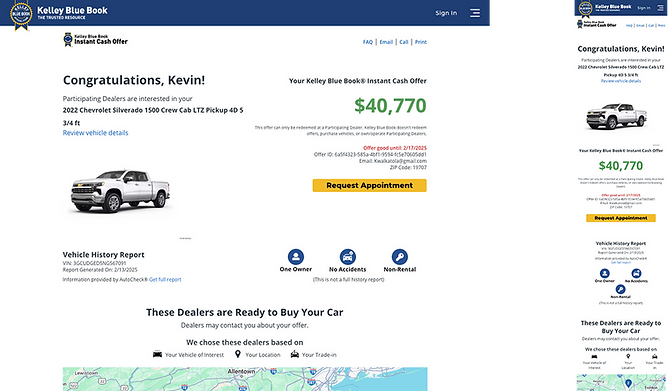
Problem Framing
How might we help consumers feel confident to transact with dealers during the car selling experience? (I ran research to find where trust broke down in the existing flow.)
The traditional car-selling process created anxiety and mistrust. Consumers lacked transparency into their vehicle’s value. There was a need to educate consumers to enable a more confident, informed decision-making experience.
Users felt vulnerable not knowing how offers were calculated
Location-based personalization made offers feel more credible
Transparency about pricing factors significantly increased trust
Featured: Key Factors Influencing The Instant Cash Offer
The cornerstone of building consumer trust and transparency
Mileage
Year, make, model of mileage significantly impact market demand and offer value
Color
Regional market conditions, local demand, and dealer inventory needs affect pricing
Condition
Vehicle condition, features, and maintenance history influence the final offer
Why This Matters
By transparently communicating the factors that influence their cash offer the consumers were empowered with knowledge. This reduced anxiety, set realistic expectations, and built trust in the Kelley Blue Book valuation process. Users understood that their offer was based on concrete, objective criteria—not arbitrary dealer decisions.
Research & Insights
Method
Closed and Why Synthesis Skills
Analyzed user behavior patterns to understand decision-making triggers and pain points in the car selling journey. Synthesized qualitative data to identify key moments of friction and opportunity.
Method
User Interviews using Usertesting.com
Conducted remote user testing sessions to gather feedback from users in the car buying/selling market. Focused on understanding emotional responses, trust factors, and information needs at each stage.
Key Insights
✓ Users felt vulnerable without understanding how offers were calculated
✓ Transparency about pricing factors significantly increased trust
✓ Location-based personalization made offers feel more credible and relevant
Stakeholder Alignment
Challenge: Balancing consumer needs with dealer business requirements and technical constraints.
Approach: Navigating trade-offs between providing complete transparency and maintaining dealer relationships. Collaborating with business stakeholders to find solutions that serving both consumers and dealers—ensuring the platform remained valuable for all parties.
How We Got Buy-In
Presented data showing that transparent, confident consumers led to higher conversion rates and more qualified leads for dealers. This win-win narrative secured stakeholder support across the organization.
Design Strategy
Strategic Approach
Created a design system that prioritized clarity, transparency, and progressive disclosure. The strategy centered on building trust through education rather than overwhelming users with information.
Rationale: The "Why" Behind Decisions
Visual Hierarchy: Placed the most critical trust-building elements (Key Factors) prominently to immediately address user anxiety
Color-Driven Design: Used recognizable +/- coloring (green or red) to make complex factors quickly scannable and memorable
Progressive Disclosure: Revealed detailed information only when users needed it, preventing cognitive overload
Solution
Polished Visuals with Annotated Reasoning
Transparent Factor Communication
Shows exactly what influences the offer—no hidden algorithms
Clear cards explaining vehicle, location, and trade-in factors
Dealer Proximity & Trust
Builds confidence by showing nearby, participating dealers
Map visualization with distance indicators and dealer contact information
Offer Consistency Messaging
Sets expectations that dealer inspection may adjust the offer
'What to Expect at the Dealership" section prepares users for next steps
Preparation Checklist
Reduces friction by telling users exactly what to bring
Complete list of required documents and items for dealer visit
Collaboration
Product Managers
Aligned design decisions with business goals and KPIs
Engineers
Ensured technical feasibility and optimized performance for data visualizations
UXers
Validated design hypotheses through continuous user testing and feedback loops
Worked closely with cross-functional teams throughout the entire design process. Regular design reviews and collaborative workshops ensured all perspectives were considered and implementation remained aligned with user needs.
Iteration
What we Learned and Changed
v1
Finding: Users were confused by technical terminology in factor explanations
→ Changed: Simplified language and added plain-English descriptions with examples
v2
Finding: Colorization
→ Emphasize embroided colors for scannable information
v3
Finding: Users missed the 'What to Expect' section buried at bottom
→ Changed: Elevated preparation information and added visual icons for better scannability
Testing & Feedback Process
Conducted multiple rounds of usability testing at each iteration. Used A/B testing for key components like the Key Factors section to validate design decisions with real user behavior data.
Impact
Quantitative Results
15%
Increase in offer transaction rate
28%
Reduction in dealer inquiries about offer calculations
22%
Of users reported feeling 'very confident' in their offer (up from 12%)
Qualitative Results
"I finally understand why my car is worth what it's worth. This takes all the mystery out of it."
— User Testing Participant
"The transparency made me trust KBB way more than other car buying services."
— Post-Launch Survey
"Knowing my car's value clears confusion and aids in decisions. Having this knowledge takes charge of my car buying journey."
— User Testing Participant
How We Got Here
The results were driven by a pivotal design decision: reimagining the Key Factors component on the Offer page. Mileage had always been a factor, but users still felt uncertain about why their offer was what it was. I designed the component for quick readability — clear, scannable elements that users could process fast. Placement was equally intentional: the offer amount stayed above the fold as the primary focal point, while Key Factors lived below — not as an afterthought, but as a supporting layer that justified the number and gave users the confidence to transact. Getting there also required navigating a real business tension around how much to reveal — KBB's valuation methodology is proprietary, and the design had to build consumer transparency without exposing our competitive advantage. By giving users the "why" behind their number without revealing the how, we turned anxiety into confidence — and confidence drove transactions.
Before & After
Need a closer look?

Before Key Factors

After Key Factors Influence
Before Key Factors

Reflection
What I Would Do Differently
Key Learning
Transparency isn't just about showing data—it's about explaining factors in human terms. The "Key Factors" approach worked because it provides additional information for consumers who are on the fence.
What I'd Change
If I could do it again, I would have involved dealers earlier in the process. Their perspectives on what information builds trust could have accelerated our iterations and prevented some early missteps.
Biggest Takeaway
Building trust in digital experiences requires meeting users' emotional needs, not just their functional ones. Users needed to feel confident and in control—once we focused on that emotional journey, the design solutions became clear.
Future Improvements
Continue testing personalization features—showing users how similar vehicles in their area performed could further build confidence. Also exploring more avenues of real-time offer updates of market conditions change.